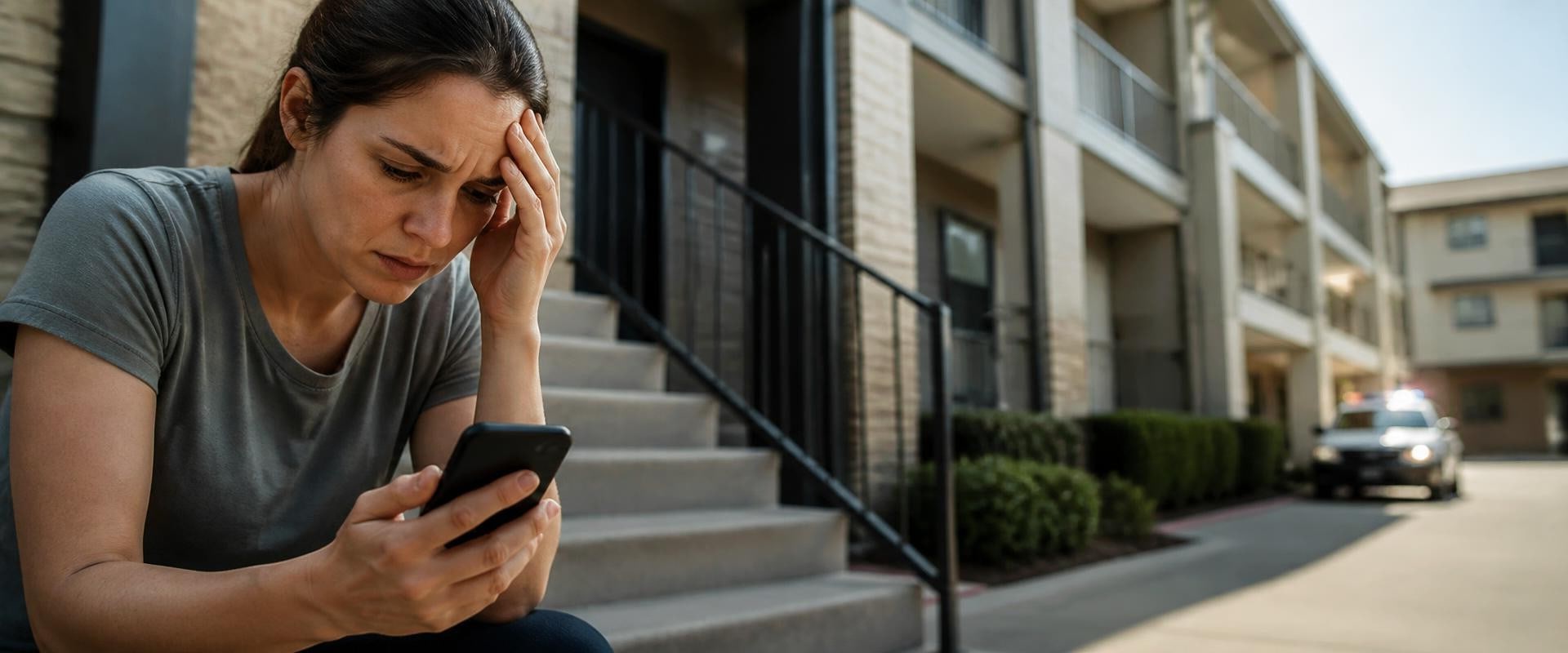
In the hours and days after a shooting or assault at an apartment complex, victims and families are understandably focused on survival: the emergency room, the police, the phone calls to relatives. Legal questions feel distant. Yet the window to protect the most important evidence in a negligent-security case is often measured in days, not months.
This post explains which evidence tends to decide apartment security cases, why it disappears so quickly, and what you can do now to protect your ability to hold a complex accountable.
The evidence that usually carries these cases
A negligent-security claim must show that the attack was foreseeable and that the complex failed to provide reasonable security. Proof of both typically comes from a handful of sources:
Surveillance footage. Video can show how the attacker got onto the property, whether gates were open, whether lighting was working, and whether any guard responded.
Crime and police-call history. Records of earlier calls to the address reveal whether the complex had a pattern of shootings, robberies, or break-ins. That history is often the heart of the case because it shows the danger was foreseeable.
Broken security equipment. The condition of gates, locks, lights, cameras, and call boxes at the time of the attack shows what failed.
Management's own knowledge. Emails, incident reports, maintenance requests, and tenant complaints reveal what the owner and managers knew and when they knew it.
Why it vanishes so fast
Apartment surveillance footage and crime-call records can disappear within days. Many camera systems automatically record over older footage. Some records are routinely purged. And once a serious crime draws attention, a complex may quickly fix the broken gate or replace the burned-out lights. Repairs are good for residents going forward, but they can erase visible proof of what conditions looked like on the night of the attack.
Witnesses are another fragile source. Neighbors move out, employees change jobs, and memories fade.
Steps you can take right now
You do not need to build a case on your own, but a few simple actions can help:
- Take photos or video of broken gates, locks, lighting, cameras, or fencing, if you or a family member can safely do so.
- Save your own records, including texts or emails to management, maintenance requests, and any notices the complex sent about crime.
- Write down what you remember about the attack and the property, while the details are fresh.
- Collect contact information for neighbors who saw what happened or who complained about security problems.
- Keep medical paperwork from every provider, beginning with the emergency visit.
- Speak with a lawyer quickly, before footage and records are lost.
Mistakes to avoid
A few common missteps can make a case harder later:
- Giving a recorded statement to the complex's insurance company before speaking with a lawyer. Adjusters are trained to gather information that limits payouts.
- Signing documents from the property or its insurer, including releases or move-out paperwork that mentions the incident.
- Posting about the attack or your injuries on social media, where comments and photos can be taken out of context.
- Assuming the police will save the video. Investigators may only collect what they need for the criminal case, not what proves the property's security failures.
What a lawyer can do that you cannot
An attorney can formally demand that the owner, the management company, and any security contractor preserve video, records, and documents related to the attack. A lawyer can also request police-call data, retain experts to inspect the property, and identify every party that may share responsibility. The earlier those steps begin, the more evidence there is to work with.
Prior complaints carry special weight
If you or other residents reported broken locks, dark walkways, or criminal activity before the attack, those reports matter. They help show that management knew about the danger and failed to act, which is strong evidence in a negligent-security case. Gather whatever you can find.
Your claim and what it can recover
It does not matter whether the attacker was a resident, a guest, or a stranger. A complex that left a foreseeable risk unaddressed may be liable. Compensation can reach hospital bills, the cost of care for the rest of the victim's life, missing wages, and physical and emotional suffering, along with a wrongful-death recovery for families who lost someone.
The Haggard Law Firm has handled nearly 500 negligent-security cases. It obtained a $16 million settlement in a Jacksonville apartment-complex shooting and the $102.7 million verdict that stands as the largest negligent-security verdict in U.S. history. These are gross amounts before fees and costs.
Call before the evidence is gone
There is no fee unless the firm wins. For a free, confidential review, call (305) 446-5700 today.
Attorney advertising. The suggestions above are general and are not legal advice for your circumstances; simply reaching out to the firm does not make it your lawyer. Prior outcomes cannot guarantee future results.